Nail Art is a Craft
Issue 01
Originally published on 29th July 2026 as part of a serialised newsletter series for Spiralling by Bethan Claire.
Preface
A note from the author
After sharing some thoughts on TikTok I received many requests to share my essay and research into the idea of nail art as a handmade craft, and it truly excites me so much that others are interested in this concept!
These newsletters are based on an essay I wrote and submitted as part of my postgraduate course in Art Gallery and Museum Studies. Since submission I have adapted and expanded the original essay as a continuation of my research. I’ve decided to share this research and writing as a serialised newsletter, which means that each edition of the newsletter is one chapter of a whole essay.
I’ll release one chapter a week via this newsletter to make it more manageable for me, and more easily digestible and accessible for you :
You can also listen to the issue by clicking the play button on the audio file at the top of this issue!
It’s October 2010 and I’m on the bus to my first nail course. It was my mum’s idea: she suggested I do a two-day accredited course in manicure because I was painting my nails non-stop, and I was pretty good at doing a neat job. A few years earlier she’d gone through a career change and had been steadily building her skills in various beauty and holistic treatments, and she could use the help doing manicures at private pamper parties and events.
My fascination with nail art began in 2011 when I came across WAH Nails on Instagram. The leopard print, camo splodges and pop art polka dots caused a wave of excitement and I immediately knew: I HAD to have those designs on my nails. But how? I was 16 and living in Nottingham. WAH was in London and far too cool for me to step into. Besides, how was I going to afford the train and the manicure when all I did was volunteer at Oxfam and help my mum out here and there by doing manicures at her pamper evenings?
I guess I’ll just give it a go myself.
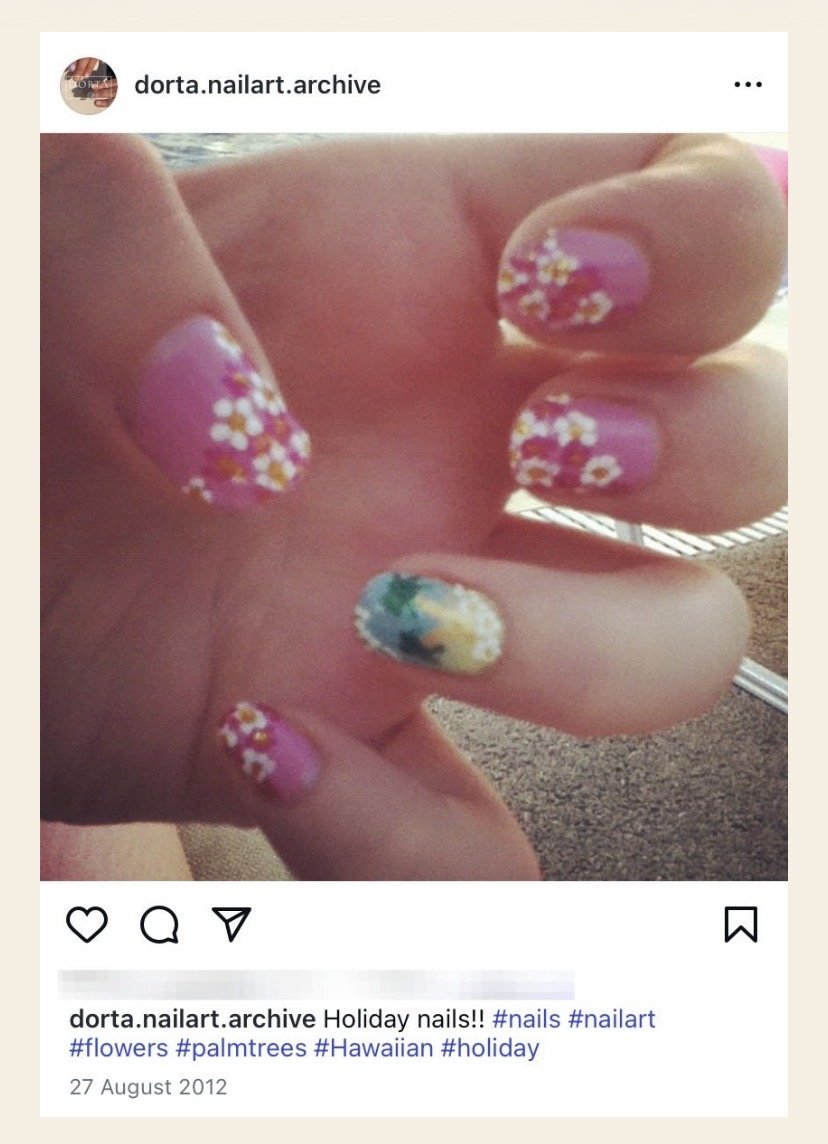
Nail art tools have been around for a long time, but like Sharmadean Reid, founder of WAH Nails, says in her 2010 VICE interview, nail art was a ‘dirty word’ and the materials available weren’t the best quality. But they were there and to me they were magic. Squeezey 2-in-1 nail art pens that were also brushes, stickers and gems that popped off minutes after the polish had dried. I studied the photographs on WAH’s instagram and recreated every design I could. It was the summer of 2011, and even then I remember thinking it was the summer of nail art and it’s still true now - that’s the summer it all began. GCSEs had just finished and I had time to sit and play. So that’s what I did.
15 years later and I’m still just as obsessed. I haven’t been able to let it go. It wasn’t a fad or a trend or a period of time. Nail art is engrained in my identity. It’s the only hobby that I’ve ever stuck at for this long, it’s the first hobby I turned into a job, the hobby I lost my love for and the hobby I learned to love again.
15 years is a long time to be so close to something. As a 31 year old it’s essentially half my life. In that time my skills and style preferences for my nails have changed along with my personality; a change reflected in the development of products, colours and techniques as well as the expectations of the clients as much as the practitioners. I’ve seen the industry evolve and I’ve seen the role of and respect towards the manicurist evolve with it. The term ‘manicurist’ itself has expanded to become an umbrella term under which more nuanced titles exist: now practitioners are nail artists and nail technicians, as well as nail influencers, business owners and brand ambassadors.
But the story began long before I picked up the book - or the brush! - and now I’m tracing back the practice of nail artistry to uncover not only its origins but its socio-cultural impact and advocate for greater respect of its workers and their craftspersonship.
*
Folk is where I have chosen to ground my arguments, and I will explain my reasoning as we embark on this newsletter series, but first I will simply share with you the comment which first sparked the digging of this rabbit hole. In May last year I was watching an online talk given by Lucy Wright for the Feminist Lecture Programme. The topic was the Feminist Reclamation of Folk. She explained that to her, folk can be defined as ‘the things we make and do for ourselves’ (Lucy Wright 2025). Quite simply, I believe that nail art is just that: it’s something we do for ourselves, that is made by the hands of one person on the hands of another. It is of the people, for the people, by the people. Nail art is therefore a deeply communal practice: we hold hands as we tell each other stories of our lives and paint pictures that reflect both the wearer and the creator. Nail art reminds us who we are and what we’re capable of achieving. It celebrates milestones with us and it bolsters us during hard times. As do the people who make it possible. They are magicians - alchemising feelings and colours, bestowing confidence with a literal flick of the wrist, a wave of a wand (see: cat eye magnet), a snap of the fingers.
Despite its positive impact both aesthetically and emotionally, there are many problems within and faced by the industry including racism, appropriation, sexism, classism and the disregard of an entire gender, as well as tensions within that gender group. The history of nail art is complex and interwoven with wider societal issues, but that’s also what makes it so important to study: nail art, the nail salon, the online community, the industry are all a microcosm, a reflection of our wider society.
In this newsletter series I will take you through some of the key writers and research in the field of nail artistry and the field of folk to explore how and where the two subjects align to support one another. My aim is to uplift the relevancy of both areas in demonstrating that nail art is a serious craft and that folk is for everyone. This exploration will be expansive in that it will cover a variety of fields and theories both academic and societal. This is partly because the influence of nail artistry is far reaching and partly because the only limitations are the ones that I set. That being said, it is likely that this initial exploration will only be scratching the surface of what is, I believe, a chronically under-researched area.
Therefore I ask two things of you, my wonderful readers, before we begin our quest:
That you keep an open mind → nail art is chronically and systematically undermined as a craft, art and behavioural practice. Because it is a playful, to some frivolous, activity it is generally not seen as serious, but this is not the case. It is a deeply meaningful expression of self, of creativity. In the way we analyse art and social behaviours we can analyse nail art.
That you are patient → this is an active piece of research and writing which I am serialising so that it is manageable to both produce and read. This format also allows for changes, new information and threads of thought to be communicated and developed in real time. It is therefore not possible to touch on every single topic within one newsletter issue and I hope you can be gentle with me as we explore this emerging field of study together.
Thank you for reading! If you have any thoughts or experiences you’d like to share with me you can get in touch via email:
hello.bethanclaire@gmail.com
You can also follow me on:
Instagram:@bethanclaire
TikTok:@bethanscraftjournal
See you for the next issue!
Bethan 💅🏻
Disclaimer
This piece was first written as a 3000 word assignment for my postgraduate MA course in Art Gallery and Museum Studies for the module of Intangible Cultural Heritage.. For the purposes of sharing my subsequent and ongoing research I have edited the originally submitted essay to expand the parameters and context (as I’m no longer restricted by a word count!). I have also adapted the tone and register at times for accessibility, flow and to sound more ‘me’.
This is therefore not a direct example of my academic work and I would not advise using it as an example of academic writing.